Sales kickoff season is almost here. This guide covers what makes an SKO work, a sample agenda, and ten ideas for turning a week of presentations into a real conversation with your team.
What is an SKO?
SKO stands for sales kickoff: the meeting, often a one to three day event, where a company brings its sales and go-to-market teams together at the start of the financial year. Most SKOs happen in January or February. The goals are usually the same: explain the strategy and targets for the year, launch new products or pricing, train reps on messaging, celebrate last year's wins and send everyone back to their territories motivated.
It is also one of the most expensive meetings a company runs. Travel, venues and a week of selling time add up quickly, so it pays to make every session count.
Why so many sales kickoffs fall flat
Most reps know what to expect from an annual kickoff: back-to-back slide decks, a lot of listening and little time to discuss what affects their pipeline. Common problems include:
- One-way communication. Leaders present for hours while the people closest to customers sit and listen.
- Unasked questions. Reps have real concerns about quotas, territories and compensation, but few will raise them at a microphone in front of the CRO and 300 colleagues.
- No feedback loop. Organisers rarely find out which messages landed and which were misunderstood until the first quarter is already slipping.
- Energy dips. Afternoon sessions on day two struggle to hold attention.
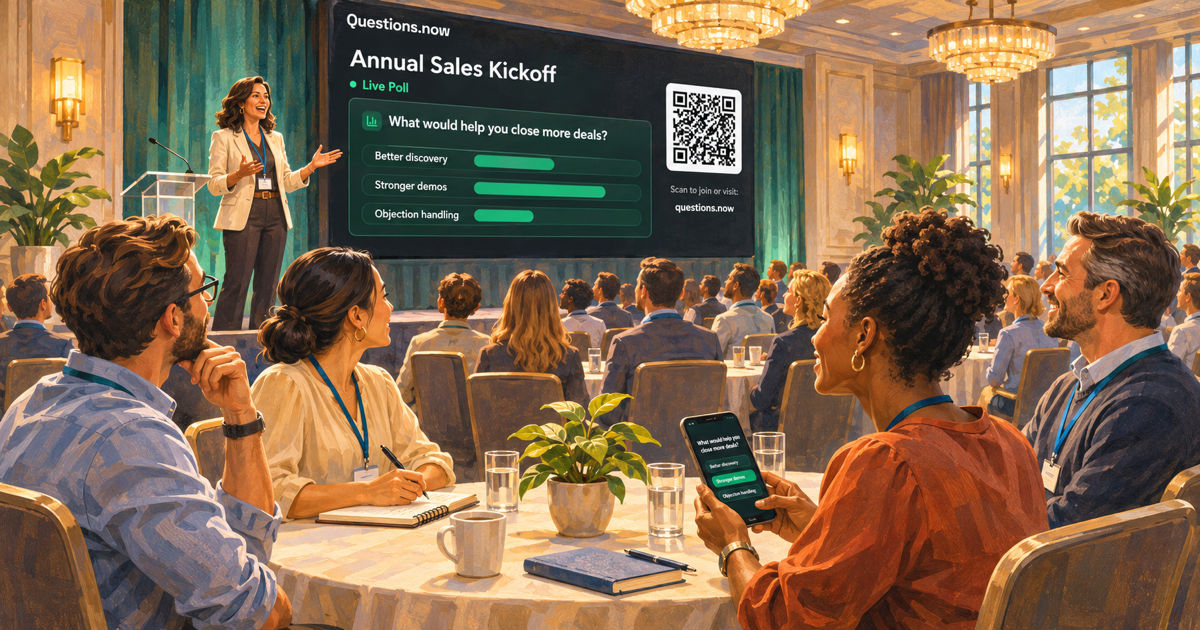
Reps stay engaged when they have an easy way to ask questions, vote and react without standing at a microphone in front of hundreds of colleagues.
A sample sales kickoff agenda
Adapt this two-day structure to your team's size and goals.
Day one: direction
- Opening and word cloud check-in (30 min): set the tone and capture how people feel about the year ahead.
- Leadership keynote: strategy and targets (60 min), followed by a 20-minute open Q&A.
- Product launches and roadmap (60 min), with polls to test understanding.
- Customer stories and win reviews (45 min).
- Awards and recognition (evening).
Day two: execution
- Messaging and objection handling workshops (90 min).
- Breakouts by region or segment (60 min), each with its own Q&A session.
- Enablement and tools training (60 min).
- Closing: commitments and final ask-me-anything with leadership (45 min).
10 sales kickoff ideas to drive engagement
1. Run a pre-SKO pulse poll
A week before the event, share a short poll asking reps what they most want covered. Use the feedback to shape keynotes and breakouts, and mention in the opening session that the schedule reflects their input. It sets a collaborative tone before anyone arrives.
2. Open with a word cloud check-in
Ask "In one word, how do you feel about next year?" and display the word cloud live. It is a fast icebreaker, and the most common words tell leadership a lot about morale. For more openers, see our 21 icebreaker activities.
3. Take leadership Q&A anonymously
The questions reps most want answered, about quotas, comp plans, territory changes or restructures, are exactly the ones they will not ask with their name attached. Anonymous Q&A brings them to the surface so leaders can address them directly instead of letting them turn into corridor rumours. Our guide to running anonymous Q&A covers how to set this up well.
4. Let upvotes set the agenda
When participants upvote each other's questions, the most important topics rise to the top. Speakers spend their time on the topics that matter most to the wider team, rather than whichever question arrived first.
5. Poll the room on the new plan
After presenting the go-to-market strategy, ask a quick poll: "How confident are you that you can hit your number with this plan?" A low score gives leadership an honest read on sentiment, and a chance to address doubts before reps head back to their territories.
6. Turn customer stories into live discussion
After a win review, invite questions for the account executive who closed the deal. Reps learn far more from "How did you get past procurement?" than from the slide summarising the result.
7. Run quick-fire product quizzes
Launching new products? Follow each demo with a three-question poll to check what stuck. It is light competition, and it shows enablement teams where follow-up training is needed.
8. Collect objections in real time
During the objection handling workshop, ask reps to submit the toughest objections they hear from customers. Upvoting reveals the most common ones, and you can work through them live as a group.
9. Use reactions to keep energy visible
Live emoji reactions on the big screen give the room a way to applaud a big announcement or a record-breaking quarter without anyone waiting for a microphone. They also give speakers a real-time read on the room.
10. Close with commitments and an open Q&A
End with a final ask-me-anything session with leadership, then a word cloud: "What is one thing you will do differently next quarter?" Seeing everyone's commitments on the main screen gives the team a shared sense of accountability for the quarter ahead.
Running a virtual or hybrid SKO
Many teams now join kickoff remotely, at least in part. Attention drops quickly when remote attendees are treated as passive viewers of a stream. Giving them the same way to ask questions, vote and react puts them on equal footing with colleagues in the room. With a tool like Questions.now, everyone joins from their phone or laptop using a QR code or short session code, and in-room and remote questions appear in the same list. Keep virtual sessions shorter, add a poll or question break every 15 to 20 minutes, and have a host read out remote questions so they get equal airtime.
For larger events, assign a moderator to group duplicate questions and keep the conversation on track. Our guide to moderating Q&A at large events walks through the process.
After the SKO: keeping momentum
- Answer what you did not get to. Export the unanswered questions and share written responses within a week.
- Share the themes. Summarise what reps asked about most and what leadership is doing about it.
- Revisit the confidence poll. Run the same poll at the end of Q1 to see whether confidence has moved.
SKO planning checklist
- Send a pre-event pulse poll and adjust the agenda.
- Create a Q&A session for each keynote and breakout.
- Display the QR code on screen at the start of every session.
- Prepare a few seed questions so the first minute is never silent.
- Brief speakers to leave real time for Q&A, at least 20 minutes for leadership.
- Assign a moderator for sessions with large audiences.
- Follow up on unanswered questions within a week.
Get your SKO ready
Questions.now gives you live anonymous Q&A, upvoting, polls, word clouds and reactions in one session, with a Presenter Mode built for the big screen. Pick a ready-made template from your dashboard and you can have your kickoff sessions set up before the agenda is finalised. Create a session and get started in seconds.